
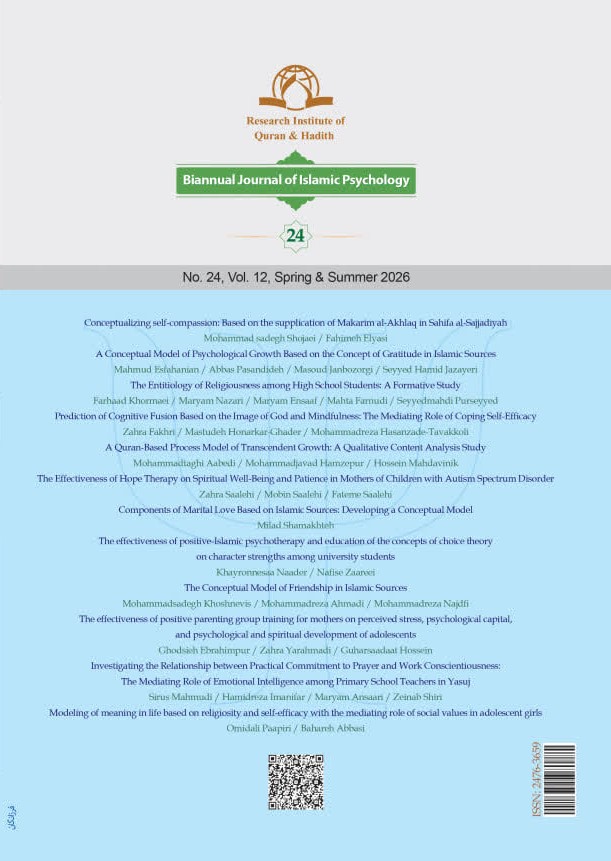
Journal of Islamic Psychology

Journal of Islamic Psychology

Current Issue: Volume 12, Issue 24, September 2026, Pages 1-333 

The Entitiology of Religiousness among High School Students: A Formative Study

Pages 57-82

10.22034/psy.2026.51913.1467

Farhad khormaei, Maryam Nazari, Maryam Ensaf, Mahta Farnoodi, Seyed Mehdi Poorseyed

Components of Friendship Based on Islamic Sources: Qualitative Content Analysis

Pages 211-245

10.22034/psy.2026.52215.1510

Mohammad Sadegh Khoshnevis, Mohammadreza Ahmadi, Mohammadreza Najafi

Keywords Cloud

  • Islamic sources
  • Islamic psychology
  • mental health
  • Islam
  • conceptual model
  • Hope
  • spiritual intelligence
  • anxiety
  • Spirituality
  • religious orientation
  • qualitative content analysis
  • positive psychology
  • psychological well-being
  • Religion
  • Holy Quran
  • resilience
  • forgiveness
  • quality of life
  • religiosity
  • gratitude
  • Patience
  • Islamic approach
  • marital conflicts
  • Life satisfaction
  • self-efficacy
  • religiousness
  • Psychology
  • prayer
  • Students
  • self-esteem
  • validation
  • Islamic teachings
  • Elderly
  • depression
  • social skills
  • happiness
  • marital satisfaction
  • Stress
  • mindfulness
  • Group therapy
  • Process Model
  • spiritual health
  • motivation
  • Anger
  • autism
  • optimism
  • Subjective well-being
  • nature
  • Psychological Hardiness
  • thankfulness
  • emotional divorce
  • Wisdom
  • family
  • Religious commitment
  • Iran
  • social adjustment
  • Factor Analysis
  • Relationship
  • educational principles of the Prophet
  • Religious attitude
  • model
  • Stages
  • Religious Texts
  • honesty
  • psychology of religion
  • Psychological capital
  • reliability
  • Systematic Review
  • Religious Beliefs
  • Attribution Styles
  • children
  • Self-control
  • Fetrat
  • curriculum
  • adolescent
  • faith
  • Self-compassion
  • education
  • image of God
  • Islamic Lifestyle
  • intellect
  • piety
  • Satisfaction
  • personality traits
  • gender
  • strategies of coping with stress
  • Family boundaries
  • Love
  • actualization
  • hatred
  • psychological trauma
  • Tension
  • therapy principles
  • Belief in afterlife
  • solidarity
  • Romantic failure
  • lengthening the Amal (aspiration)
  • Love trauma
  • blind girls
  • Spiritual Support
  • regulation of sexual behavior
  • religious coping style
  • satellite
  • Attention-Sexual Security Natural Intellect
  • Religious Measurement
  • Choice theory
  • normal behaviors
  • man
  • Cognitive-behavioral therapy
  • Religious family therapy
  • Islamic Self-control
  • revenge
  • paying attention to God
  • psychological comprehension
  • people who memorized the Quran
  • religious wisdom
  • infidelity
  • Couple interaction
  • Imam Ali
  • existential anxiety
  • spiritual well-being
  • conceptualization of talent
  • Farah
  • intention
  • Book
  • Holy Koran
  • Conceptualization
  • dimensions of religiosity
  • spiritual and moral care
  • moral norm
  • conventional method of content analysis
  • marriage stability
  • housekeeper women
  • Relationship model
  • Women
  • growth obstacles
  • Islamic texts
  • Keywords: Hope therapy
  • early maladaptive schemas
  • immortality
  • Content Validity
  • Personality factors
  • life satisfaction
  • Positive attitudes towards children
  • Godly spiritual parenting
  • Developmental Model
  • Psychological Dimensions
  • Childbearing
  • Aspiration
  • Enright
  • pain
  • spiritual interventions
  • extramarital relationships
  • هوش هیجانی
  • dishonesty
  • emptiness depression
  • seminary school students
  • forgiveness scale
  • Islamic spiritual therapy
  • Acceptance
  • identity
  • university
  • mood swings depression
  • friendship
  • Eudaimonic Well-being
  • positive feeling towards spouse
  • self-communication
  • : Spiritual psychotherapy
  • Psychological Factors
  • suffering
  • Meta-analysis
  • Sahifa al-Sajjadiyah
  • Meaning of suffering
  • thematic analysis
  • substance abuse
  • life expectancy
  • Explicit theories
  • Group discussion
  • semantics
  • behavioral inhibition
  • desire
  • Factors reducing
  • types of talents
  • family psychology
  • behavioral approach
  • Adaptation
  • a single-subject multiple–baseline pattern
  • blessings
  • Spiritual-religious therapy
  • Romantic Breakdown
  • armies of wisdom and ignorance
  • psychology education
  • prescriptive text
  • Attachment style to God
  • Positive change
  • parental bonds
  • functions and roles of spouses
  • positive and negative affect
  • Formative Entitiology
  • semantic network

Related Journals